
It smells yummy — Permacultura e prima infanzia nella Food Forest
"It smells yummy," [child]
English version
Since last year, the Hub children have been connecting with the Food Forest through a meaningful project. It is intended to expose children to permaculture from a young age. This helps develop fine and gross motor skills through physical experiences, fostering patience and responsibility while encouraging healthy eating habits. Moreover, "Children can reveal themselves to be very adept at taking on permaculture concepts when they are presented to them at an early age. [...] The ethics -- earth care, people care and fair share (or return of surplus) -- make sense to a child's sense of justice and understanding of their place in the world." (Permaculture educator, L. Carter, 2015).
Therefore, today Mentors invited the Hub children into the Food Forest to investigate the garden in search of harvestable vegetables to use in the Mini Chefs Project happening this Friday with another Mentor.
Mentor Sofia and another Mentor guided the Hub children to sit down and recall how to behave in the Food Forest. [childA] and [childB] proudly shared: "Light Feet, Gentle Hands, and Soft Voices."
Then, Mentors encouraged the children to hold hands and walk to the garden together to foster support and care for one another. This was spontaneously embodied throughout the whole experience; when [child] stayed a bit behind, [childA] and [childB] went back to hold [child]'s hand. The same occurred between [childA] and [childB].
At the Food Forest, the children were supported to walk on the footpaths and remain mindful of not stepping on growing plants, which aids their spatial awareness development.
The first discovery was a ginormous watermelon, which the children at first thought was a "big apple." As we counted how many watermelons there were -- exposing the children to early numeracy -- they came across a very tiny rockmelon. This led to a tactile experience as they compared the smooth surface of the watermelon to the rough surface of the rockmelon.
As they continued to explore, the Hub children encountered the friendly ducks. Mentors reminded them to keep their "Soft Voices and Light Feet" to make the animals feel safe. As the children did so, the ducks came closer and the children showed respect for each other's space. They curiously followed the ducks from a distance, which led them to a native Australian fruit, the lilly pilly. The children stretched and reached up to pick the lilly pilly fruits to taste their juiciness, then began collecting some for their Mini Chef encounter.
The Hub children really wanted strawberries. As the Mentors led them toward the strawberry plants -- which the older Hub children had planted exactly a year ago -- the children spontaneously practised their gross motor skills. To reach the plants, the children had to navigate a path made of different-sized logs. They practised patience as they waited for each other's turn and supported one another across the challenging path.
Since there were no strawberries, their attention shifted to the chickens and then to the orange pumpkins. The children spontaneously inquired about the pumpkins' texture, just as they had with the watermelons.
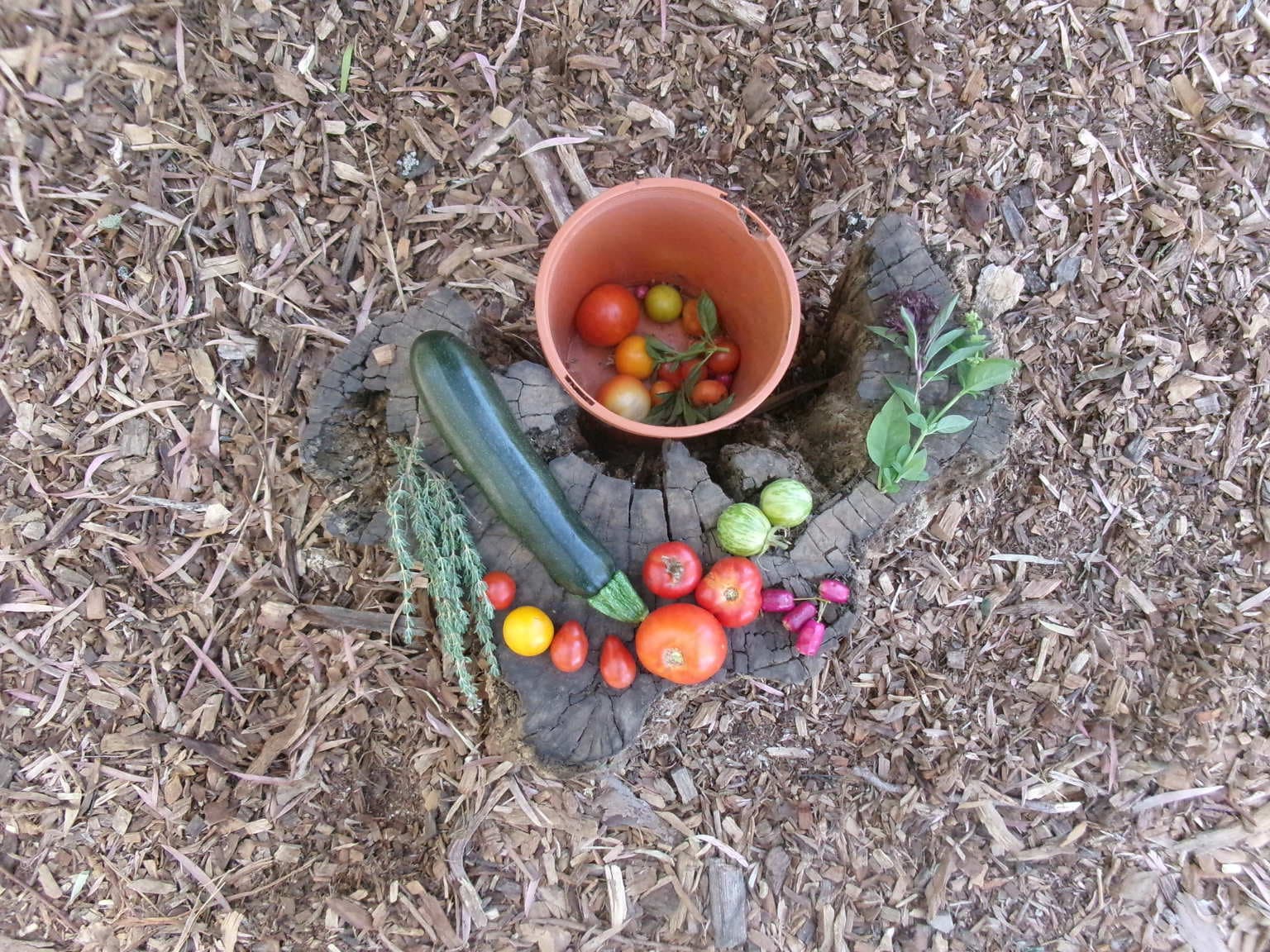
Another Mentor and a few children were led into the vegetable garden to search for tomatoes. This caught the attention of the other children, and together they began harvesting red tomatoes and sparking conversations about the "green-not-yet-ready" ones. During the process, the children found a zucchini and different herbs to smell, such as basil, Thai basil, and thyme.
Before leaving the Food Forest, the Hub children sat down and investigated what they had collected. They looked at the colours, shapes, and smells of the vegetables, and together discovered the names of the unfamiliar ones.
This caught the attention of [children] from the Gardeners room. Therefore, Mentor Sofia asked for their help in explaining to the Hub children what they needed to do once they left the Food Forest. [child] proudly said, "Wash your hands." When Mentor Sofia asked why, [child] explained to the Hub children that it was because they needed to "go to lunch," and [child] added, "Because you touched the chickens." Another Mentor noted that while the Hub children didn't pat the animals, they definitely explored the soil, and agreed with [child] about washing their hands to clean away germs.
During lunchtime, Mentor Sofia asked the Hub children about their visit and supported their co-narration using the vegetables collected. Through open-ended questions like "Where did you go this morning?" or "What's this veggie called?", the children were encouraged to verbalise and reflect on their experience while including their peers.
The Hub children who stayed at the homestead shared their encounter with another Mentor, which included picking grapes and cutting apples to make a yummy fruit salad.
With kindness, Mentor Sofia
Versione italiana
"Ha un profumo buonissimo," fin dall'anno scorso i bambini dell'Hub si stanno connettendo con la foresta del cibo attraverso un progetto significativo. L'intento è esporre i bambini alla permacultura fin dalla prima infanzia. Questo contribuisce a sviluppare le abilità motorie fini e grossolane attraverso esperienze fisiche, favorendo pazienza e senso di responsabilità, mentre incoraggia abitudini alimentari sane. Inoltre, "I bambini possono dimostrarsi molto capaci di comprendere i concetti della permacultura quando vengono presentati loro fin da piccoli. [...] L'etica -- cura della terra, cura delle persone e giusta condivisione (o restituzione del surplus) -- ha senso per il senso di giustizia del bambino e per la comprensione del proprio posto nel mondo." (Educatore di permacultura, L. Carter, 2015).
Per questo motivo, oggi le Mentors hanno invitato i bambini dell'Hub nella foresta del cibo per investigare il giardino alla ricerca di verdure pronte per il raccolto da utilizzare nel progetto Mini Chefs che si terrà questo venerdì con un'altra mentor.
Mentor Sofia e un'altra mentor hanno guidato i bambini dell'Hub a sedersi e a ricordare come comportarsi nella foresta del cibo. [childA] e [childB] hanno condiviso con orgoglio: "Passi leggeri, mani gentili e voci morbide."
Successivamente, le Mentors hanno incoraggiato i bambini a tenersi per mano e a camminare insieme verso il giardino, per favorire supporto e cura reciproca. Questo è emerso spontaneamente durante tutta l'esperienza; quando [child] è rimasto un po' indietro, [childA] e [childB] sono tornati indietro per prendergli la mano. La stessa cosa è accaduta tra [childA] e [childB].
Nella foresta del cibo, i bambini sono stati sostenuti nel camminare sui sentieri e nel rimanere consapevoli di non calpestare le piante in crescita, il che favorisce lo sviluppo della loro consapevolezza spaziale.
La prima scoperta è stata un'enorme anguria, che inizialmente i bambini hanno pensato fosse una "grande mela". Mentre contavamo quante angurie c'erano -- esponendo i bambini alle prime esperienze di numeracy -- hanno trovato anche un piccolissimo melone. Questo ha portato a un'esperienza tattile, mentre confrontavano la superficie liscia dell'anguria con quella ruvida del melone.
Continuando l'esplorazione, i bambini dell'Hub hanno incontrato le anatre amichevoli. Le Mentors hanno ricordato loro di mantenere "voci morbide e passi leggeri" per far sentire gli animali al sicuro. Facendo così, le anatre si sono avvicinate e i bambini hanno mostrato rispetto per lo spazio reciproco. Hanno seguito le anatre con curiosità da una certa distanza, il che li ha portati a un frutto nativo australiano, il lilly pilly. I bambini si sono allungati e hanno raccolto i frutti di lilly pilly per assaggiarne la succosità, iniziando poi a raccoglierne alcuni per la loro esperienza Mini Chef.
I bambini dell'Hub desideravano molto trovare delle fragole. Mentre le Mentors li guidavano verso le piante di fragole -- che i bambini più grandi dell'Hub avevano piantato esattamente un anno prima -- i bambini hanno spontaneamente praticato le loro abilità motorie grossolane. Per raggiungere le piante, dovevano attraversare un percorso formato da tronchi di diverse dimensioni. Hanno esercitato la pazienza aspettando il proprio turno e sostenendosi a vicenda lungo il percorso impegnativo.
Poiché non c'erano fragole, la loro attenzione si è spostata verso le galline e poi verso le zucche arancioni. I bambini hanno spontaneamente posto domande sulla consistenza delle zucche, proprio come avevano fatto con le angurie.
Un'altra mentor e alcuni bambini sono stati guidati nell'orto per cercare pomodori. Questo ha attirato l'attenzione degli altri bambini e insieme hanno iniziato a raccogliere pomodori rossi, avviando conversazioni su quelli "verdi-non-ancora-pronti". Durante il processo, i bambini hanno trovato una zucchina e diverse erbe da annusare, come basilico, basilico thai e timo.
Prima di lasciare la foresta del cibo, i bambini dell'Hub si sono seduti e hanno investigato ciò che avevano raccolto. Hanno osservato i colori, le forme e gli odori delle verdure, scoprendo insieme i nomi di quelle meno familiari.
Questo ha attirato l'attenzione di [children] della stanza Gardeners. Per questo motivo, Mentor Sofia ha chiesto il loro aiuto per spiegare ai bambini dell'Hub cosa fosse necessario fare una volta usciti dalla foresta del cibo. [child] ha dichiarato con orgoglio: "Lavarsi le mani." Quando Mentor Sofia ha chiesto il motivo, [child] ha spiegato ai bambini dell'Hub che era perché dovevano "andare a pranzo", e [child] ha aggiunto: "Perché avete toccato le galline." Un'altra mentor ha osservato che, anche se i bambini dell'Hub non hanno accarezzato gli animali, hanno sicuramente esplorato il terreno, ed è stata d'accordo con [child] sul lavarsi le mani per eliminare i germi.
Durante il pranzo, Mentor Sofia ha chiesto ai bambini dell'Hub della loro visita e ha sostenuto la loro co-narrazione utilizzando le verdure raccolte. Attraverso domande aperte come "Dove siete andati questa mattina?" oppure "Come si chiama questa verdura?", i bambini sono stati incoraggiati a verbalizzare e riflettere sulla loro esperienza includendo i loro pari.
I bambini dell'Hub che sono rimasti nella homestead hanno condiviso la loro esperienza con un'altra mentor, che ha incluso raccogliere uva e tagliare mele per preparare una deliziosa macedonia di frutta.
Con gentilezza, Mentor Sofia